How to Graph Inequalities on a Number Line
Graphing inequalities on a 1-dimensional number line is a foundational algebra skill. Whether you're solving simple inequalities like $x > 3$ or complex multi-step expressions like $2x - 6 \ge 6(x - 2) + 8$, this guide breaks down the rules of open vs. closed circles and shading direction.
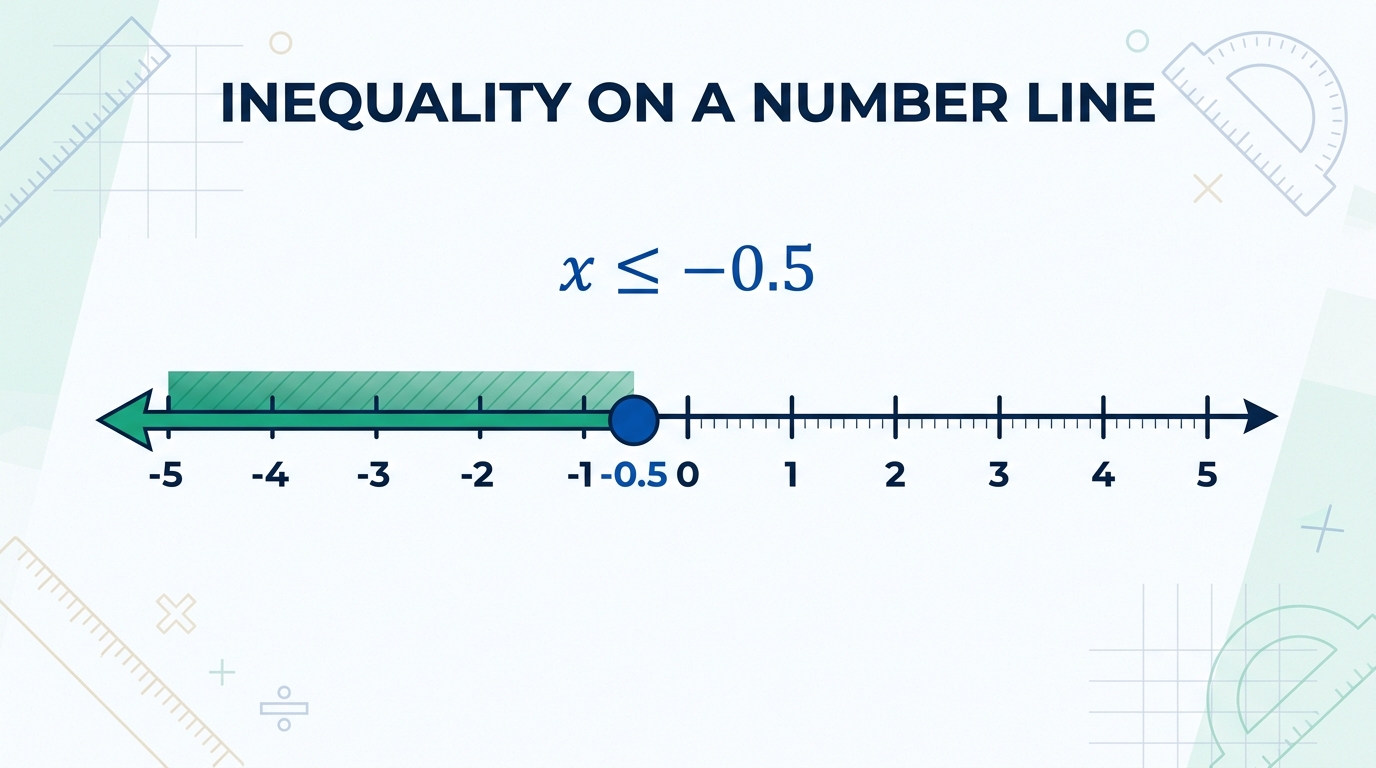
The 3 Core Rules for Graphing Any Inequality
Rule 1: Solve the Inequality for the Variable
Before plotting, isolate the variable on the left side of the inequality. Remember that if you multiply or divide both sides by a negative number, you must flip the inequality sign (e.g. $-2x \le 4 \Rightarrow x \ge -2$).
Rule 2: Determine Circle Type (Open vs. Closed Dot)
- Closed Circle (Solid Dot •): Use when the boundary number IS included ($\le$ or $\ge$).
- Open Circle (Hollow Circle ∘): Use when the boundary number IS NOT included ($<$ or $>$).
Rule 3: Shade the Solution Direction (Ray)
- Shade Right ($\rightarrow$): For "greater than" ($>$ or $\ge$). Values grow larger toward $+\infty$.
- Shade Left ($\leftarrow$): For "less than" ($<$ or $\le$). Values grow smaller toward $-\infty$.
Example Problem: $2x - 6 \ge 6(x - 2) + 8$
Let's solve and graph this multi-step inequality step by step:
Graphing Result: Place a solid closed circle at $-0.5$ (since it is $\le$) and shade a heavy line pointing left toward negative numbers.
Practice Graphing Inequalities Digitally
Test your inequality skills on our free interactive workspace with negative numbers, fractions, and custom step sizes.