How Number Line Worksheets Can Help Children Understand Math
For many young children, math becomes difficult when numbers stop feeling like something they can actually see. A child may know that 8 comes after 7, for example, but that doesn't always mean they understand why. The same thing happens with addition and subtraction. A child can memorize that 8 + 4 = 12 without really understanding what is happening between those numbers.
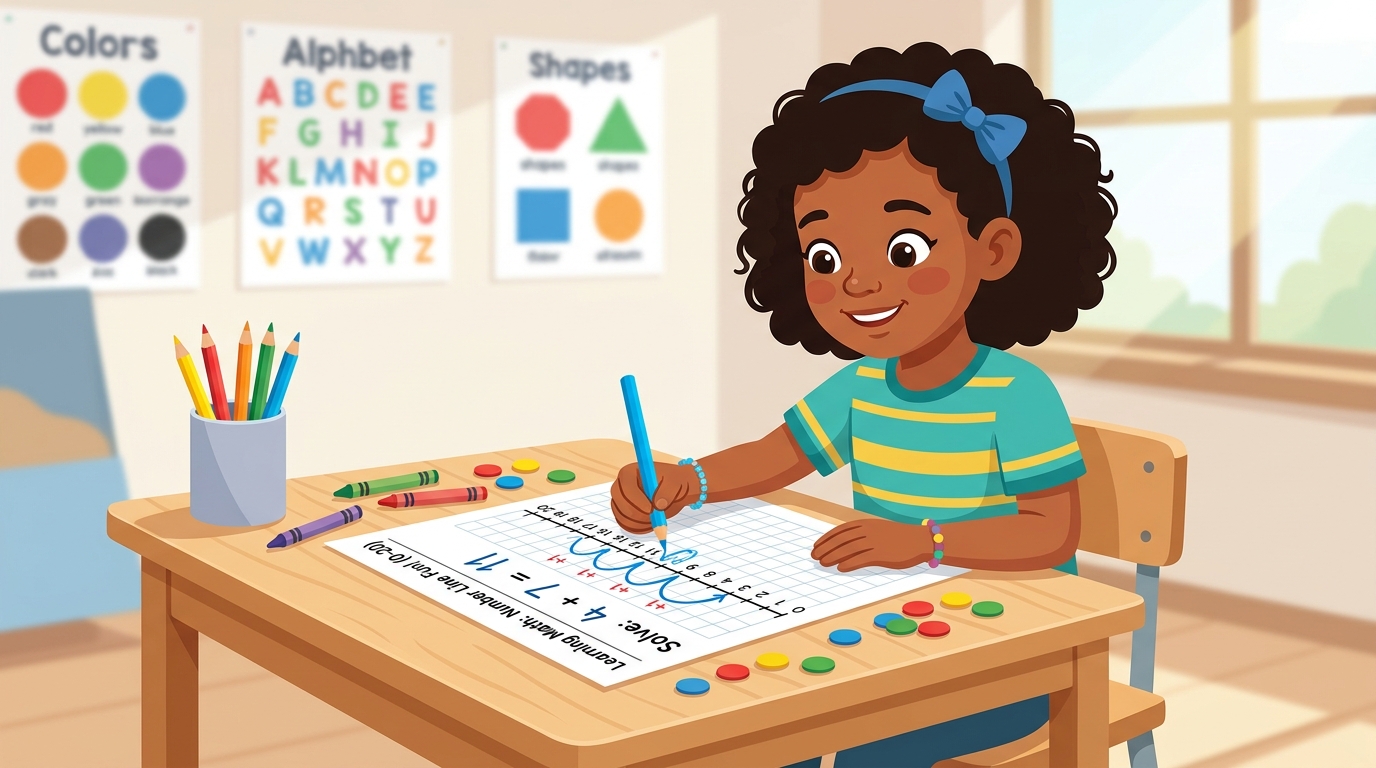
This is where a number line can be surprisingly useful. Instead of asking children to work only with symbols, a number line gives them a visual way to see numbers, their order, and the distance between them. With a simple worksheet, children can practice counting, comparing numbers, adding, subtracting, skip counting, and eventually working with fractions and decimals.
Why Number Lines Are Useful for Learning Math
A number line is a simple tool: numbers are arranged in order along a line, with equal spaces between them. But for a child who is still developing number sense, that simple picture can answer questions that are difficult to explain with words alone:
A child can actually see these relationships on a number line.
Building Number Sense
Number sense is more than being able to recite numbers. It is understanding how numbers relate to each other.
For example, a child who regularly works with a number line from 0 to 20 begins to notice that 7 is three spaces away from 10 and two spaces away from 5. They start to recognize patterns instead of treating every number as a separate fact to memorize. That understanding becomes useful later when children begin working with larger numbers, mental math, fractions, and more complicated calculations.
Making Addition and Subtraction Easier to See
Addition can be shown as movement to the right. Subtraction can be shown as movement to the left.
The child can see that four steps forward from 8 lands on 12. This doesn't replace learning basic math facts—it gives children another way to understand what those facts actually mean. Try our addition and subtraction generator to visualize this in real time.
Different Types of Number Line Worksheets
Not every worksheet needs to teach the same skill. The best choice depends on what the child is currently learning.
1. Number Line Worksheets for Counting
Simple number lines are a good starting point for younger learners. A worksheet might show: 1, 2, __, 4, __, 6. The child fills in the missing numbers. As they become comfortable, increase range to 1–50 or 1–100.
2. Finding Numbers on a Number Line
Giving children a number line with only some numbers labeled—for example, finding where 7 belongs between 5 and 10. Helps children understand position and equal spacing, which is crucial for future work with estimation, fractions, and decimals.
3. Addition & Subtraction Number Lines
Once movement is understood, number lines make arithmetic visual:
• 12 - 5: Start at 12 and move 5 spaces to the left.
• 6 + 7: Start at 6 and move 7 spaces to the right.
4. Missing Number Line Worksheets
Presents gaps where children figure out patterns: 2, 4, __, 8, __, 12 (increasing by 2). Can also count by 5s, 10s, or custom intervals.
Using Number Lines by Grade Level
The same number line doesn't have to be used throughout elementary school. As children learn more mathematics, the number line can become more sophisticated too.
Number Line Worksheets for Grade 2
By second grade, children are usually working with larger numbers and more involved addition and subtraction. Number line worksheets can extend to 100 or even 1,000 and can be used for addition, subtraction, skip counting by 2s, 5s, and 10s, comparing numbers, place value, rounding, and finding missing numbers.
Number lines can also be connected to everyday situations. A worksheet might ask a child to track money, compare distances, or work out how much time has passed—making math feel like a practical real-world skill.
Number Line Worksheets for 4th Grade
Older students can use number lines for concepts that go well beyond basic counting:
- Fractions: A number line shows that 1/2 sits between 0 and 1, while 1/4 is closer to 0. Try our fraction number line tool to plot fraction points.
- Decimals: A decimal number line helps students see where values such as 0.2, 0.5, and 0.8 belong relative to whole numbers.
- Estimation & Rounding: Visualizing rounding thresholds for larger numbers.
Using Number Lines to Solve Word Problems
Word problems can be difficult because children have to figure out what the question is asking before they can even start calculating. A number line can give them somewhere to put the information.
“Sam has 8 stickers and gets 5 more from his friend. How many stickers does he have now?”
How a child uses the number line to solve it:
- Start at 8.
- Recognize that the number is increasing.
- Move five spaces to the right.
- Land on 13.
The number line gives the child a way to represent the story rather than trying to hold the entire problem in their head. For subtraction, the process works in the opposite direction. The important thing isn't simply getting the correct answer; children are learning how information in a word problem translates into a mathematical action.
Make Number Line Practice More Hands-On
Worksheets are useful, but children don't always need to sit at a desk to practice number lines. Try turning the idea into a physical activity:
Floor Jump Game
Put numbers on the floor and ask a child to stand on 5 and take three steps forward.
Guess My Number
Give clues like: “My number is greater than 6 but less than 10.” Use the number line to narrow options.
Board Games
Any game moving forward or backward by spaces provides built-in number line practice.
These activities can be especially helpful for children who become bored with repeated worksheet exercises.
What About Digital Number Lines?
Paper worksheets are still useful, but digital tools offer another way to practice. With an interactive number line, children can move along the line, create jumps, change their answers, and correct mistakes immediately.
For example, an online number line can be used to demonstrate addition by creating a series of jumps from the starting number to the answer. This is helpful when a child needs to experiment: they can try an answer, see where they land, and adjust their thinking without having to erase an entire worksheet.
Online Number Line provides interactive tools for areas such as addition and subtraction, fractions, decimals, negative numbers, and skip counting.
The Goal Isn't Just Getting the Answer
A number line isn't a replacement for learning arithmetic facts. Its real value is that it gives children another way to think about numbers. A child who understands why 8 + 4 lands on 12 is in a stronger position than a child who has simply memorized the answer.
The same idea carries forward as math becomes more complicated. The number line that starts with simple counting can eventually be used for larger numbers, fractions, decimals, estimation, and other concepts. For parents and teachers, the best approach is usually to use number lines alongside other forms of practice—combining worksheets with games, physical activities, mental math, and hands-on examples.
Try a Number Line Yourself
If you're looking for a simple way to introduce or reinforce these concepts, start with a small range such as 0–20. Ask a child to find numbers, fill in missing values, count forward and backward, and solve a few addition or subtraction problems using jumps. Once that feels comfortable, increase the range and introduce skip counting, fractions, decimals, or word problems.
A number line is simple enough for a beginner, but flexible enough to remain useful as a child's math skills grow.